
Nobody Told Me What Being a High Achiever Actually Costs — and Here's How I'm Changing It
I told myself I had outgrown them. For years, I called it ambition — not having time for people, growing apart from friends who weren't climbing. COVID arrived, my long-term relationship collapsed, and I couldn't think of a single person to call.


There's a difference between choosing solitude and having no one to call when life falls apart. A painful realisation that reverberated across the 14 years of my corporate career.
In this article, I will touch upon:
- the friendships I let go of because I thought I'd outgrown them
- when I stopped treating my husband like an interruption
- the three things I'm doing differently now
I've been fortunate to build a career that I genuinely love.
I entered cybersecurity almost by accident, discovered it was exactly what I wanted to do, and I threw myself into it. I worked hard, got recognised early, received promotions quickly, and every achievement reinforced the belief that I had to keep pushing.
But a pattern began to emerge with the early promotions.
I told myself I had outgrown my friendships. I had just stopped showing up.
For years, I convinced myself that I was simply ambitious. That I didn't have time for people. That climbing the corporate ladder naturally meant growing apart from friends.
Looking back now, I don't think that was true. Some friendships ended because people changed, and that's okay. But there are a few genuinely good people I pushed away for no reason other than believing my career mattered more.
I had two close friends who were genuinely the nicest people I have ever met. We were friends for almost three years and were inseparable at work. After I changed jobs and moved to a different city, I slowly stopped making any effort to stay in touch. Deep down, I had convinced myself that I had outgrown the friendship. I told myself that I needed ambitious people around me, people climbing the corporate ladder like I was. I dismissed them as being too carefree.
I now realise there was absolutely nothing wrong with them. I was sacrificing good relationships for a version of success that demanded everything from me.
At that time, I never thought these decisions would have consequences.
I genuinely enjoy my own company. I love having my me time. I convinced myself I didn't need anyone.
You might want to read: The Guilt of Not Overworking: Why Earning More Made My Anxiety Worse, Not Better
The Collapse
This mindset cost me hard during COVID.
My long-term relationship collapsed in a very painful way, and I didn't have a single close friend I felt comfortable calling.
Instead of asking for help, I tried to numb everything. I drank more. I binged on junk food. I slept for hours. I cried myself to sleep. I couldn't focus on work.
Then I started looking for connection in completely wrong places.
I downloaded dating apps and repeatedly chose emotionally unavailable people or people I thought I could "fix." What I now realise is that I wasn't really looking for a relationship.
I was looking for companionship to share things, to talk to, to be cared for.
Around the same time, my health also started declining, and there were things I couldn't even share with my family.
I was successful on paper.
But I had never felt lonelier.
Work was making me miserable, and I passed it straight to my husband.
The pattern did not stop with my friendships. It also started seeping into my family life.
I married the sweetest person I ever met 2 years ago. And to my horror, I let my high-achieving mindset affect our relationship, affect the attention I had promised myself that I would give him.
I would shout at my husband for coming to say hi to me when I was working. He had this habit of peeking into my room to check if I was doing okay. But the high-achiever in me would feel irritated with the gesture.
When he eventually stopped coming into my room during work hours, I realised the consequences of my actions. For what goals was I being this competitive and dismissive with my husband? All my life, I waited for a partner like him, only to neglect him as if he were not important. It pained me deeply.
Also read - The Life I Lived Out of Obligation While Waiting for My Own to Begin
My level of anxiety rose in direct proportion to the increasing workload. I had this notion in my head that work would be relaxing once I climbed higher. Needless to say, I was wrong. I couldn't even focus on a conversation without my mind drifting back to work, what was pending, what would go wrong and a thousand different scenarios.
At night, when my husband would try to share some of his frustrations from work, all I could think of was how to fix a problem I was having at work. It was incredibly selfish of me.
Work was being an asshole to me, and I was an even bigger one to my husband.
If you have read this far, consider supporting my work with a coffee ☕. Completely optional.
So What Am I Doing Differently Now?
I knew something had to give. Work wasn't giving me the comfort, love and care for the sacrifices I was making. I was already burnt out, suffering from anxiety, attaching identity to my work, and it was showing up through my health, my dwindling relationships, and how I saw myself.
- I started to plan my work well in advance so I wouldn't panic when the next week came. I blocked focus hours in my workday and did all my critical tasks during those hours. If my husband worked from home that day, I would let him know I would be occupied with my work for the next 2-3 hours. He respected that boundary and the advance notice. Once my focus hours were done, I relaxed and welcomed all the cute distractions my husband would do throughout the day. Life is too short and the time we have together is even shorter. Spending time with him should be my priority, and it took me this long route to figure that out.
If you are curious, I diligently use this template in OneNote to help me plan throughout the week:
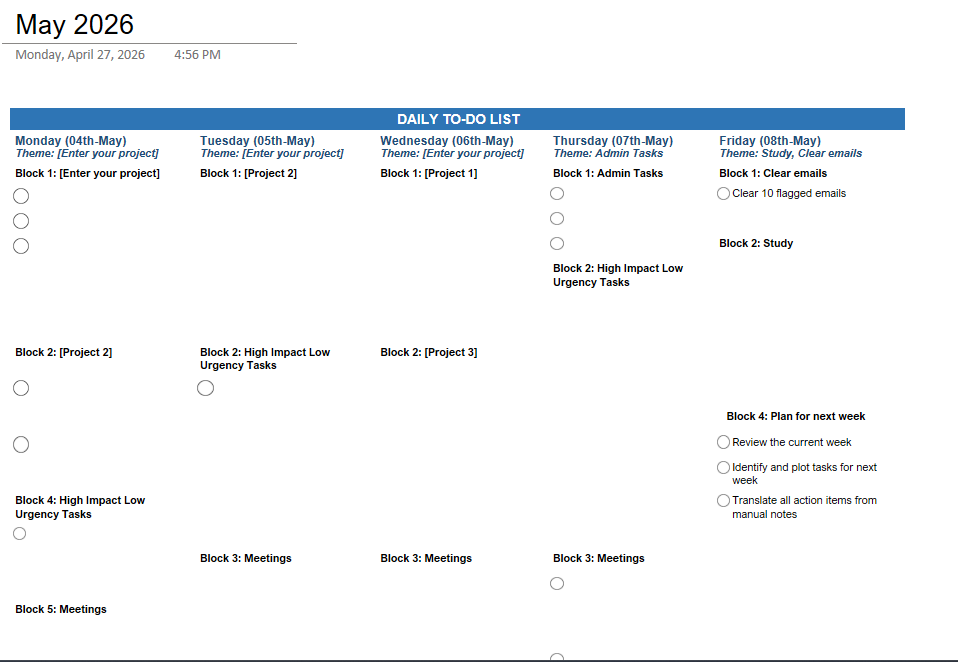
- Initially, it was uncomfortable for me, but I eventually started reaching out to colleagues who do not work in the same domain. I proactively spoke with them and was pleasantly surprised by the refreshing turn each conversation took. I realised that everyone had a different personality that made them unique, and I liked observing the good traits. Mind you, I'm an introvert to start with, and the high-achiever mindset had cleaned out whatever crumbs of social instincts and needs I had left. This small change came as a breath of fresh air to me.
- I also deliberately started being less competitive in my work. I noticed people wanting to take credit for my work or make it their own, which really bothered me at times, but now I don't let it consume me anymore. When I realise something like this is happening, I immediately pause and think: What's the worst that happens if someone takes ownership of my work? I trust my capabilities enough to find out some other work or, better, relax for the time being! I can focus on building my side hustles in the free time I get.
- This change in my mindset completely shifted the game for me. I don't even feel upset now because at the end of the day it's just work. No one is going to remember what I did at work after a few years.
Three things this madness of being a high-achiever finally named for me:
- I wasn't protecting my time. I was protecting a scoreboard nobody else was checking.
- The people I called "too carefree" were just people who had figured out something I hadn't.
- Nobody at work will remember what I delivered. My husband will remember every time I made him feel like an interruption.
I have not perfected the balance between being a high achiever and maintaining my sanity or my relationships. But I have made peace with the fact that I have a creative, analytical brain that will never turn off even if I tried to. And the best way to utilise it is to channel it towards something that matters to me and doesn't take away the precious time I've with my family.
See you in the margins.