How a Second-Person POV Can Help Reduce Your Work Anxiety
I used to believe that if I led something, I was also responsible for making sure it succeeded. Learning to separate what I can control from what I’m accountable for changed how I approach work — and significantly reduced my anxiety.


Every single year, I dreaded a project that only I knew how to lead successfully. This created an anxiety loop that I avoided looking forward to. This year was no different. As the days crept in, I knew I had to get into it. Because it was such a critical project, all eyes were on it, and I somehow took its outcomes as a projection of myself. I couldn't afford to fail.
This led to sleepless nights, mid-day panic, and an inability to focus on anything other than the project's outcome. I knew something had to change because as long as I was in my current role, I would not be able to avoid working on it.
One night, as soon as the anxiety crept in with all the worst-case scenarios playing in my head, I mustered the courage and asked myself, what part of this project was actually worrying me? Which outcome is generating the fear within me? When I tried to be realistic and practical with questions, the thoughts quietly melted away.
The next day, I jotted down all the parts that were pain points in this project along with what was being done about it. The most important part that I added was what I could do here to eliminate these pain points. When I started building out the plan, I had an epiphany.
Why am I taking accountability for the entire project and its outcome? I am the one leading it, but it is not my project. I am not paying for it. So why was I feeling responsible for areas that were beyond my control?
I scheduled a meeting with the leaders, shared all the pain points and what we could do versus what we couldn't, put the decision-making power on them and provided them with the options to achieve a successful outcome. I no longer owned or controlled the outcome. All I had to do now was follow what I knew and deliver the project regardless of the outcome.
Welcome to the Second-Person POV
This cross-questioning in my brain in the middle of the night prompted me to not only figure out how to drive the project to success without overburdening myself, but also reduced my anxiety to such an extent that I created this 4-step process that I now use for every single aspect of my work. And I want to share this with all the high-achievers who are burning themselves out by taking responsibility for every single thing.
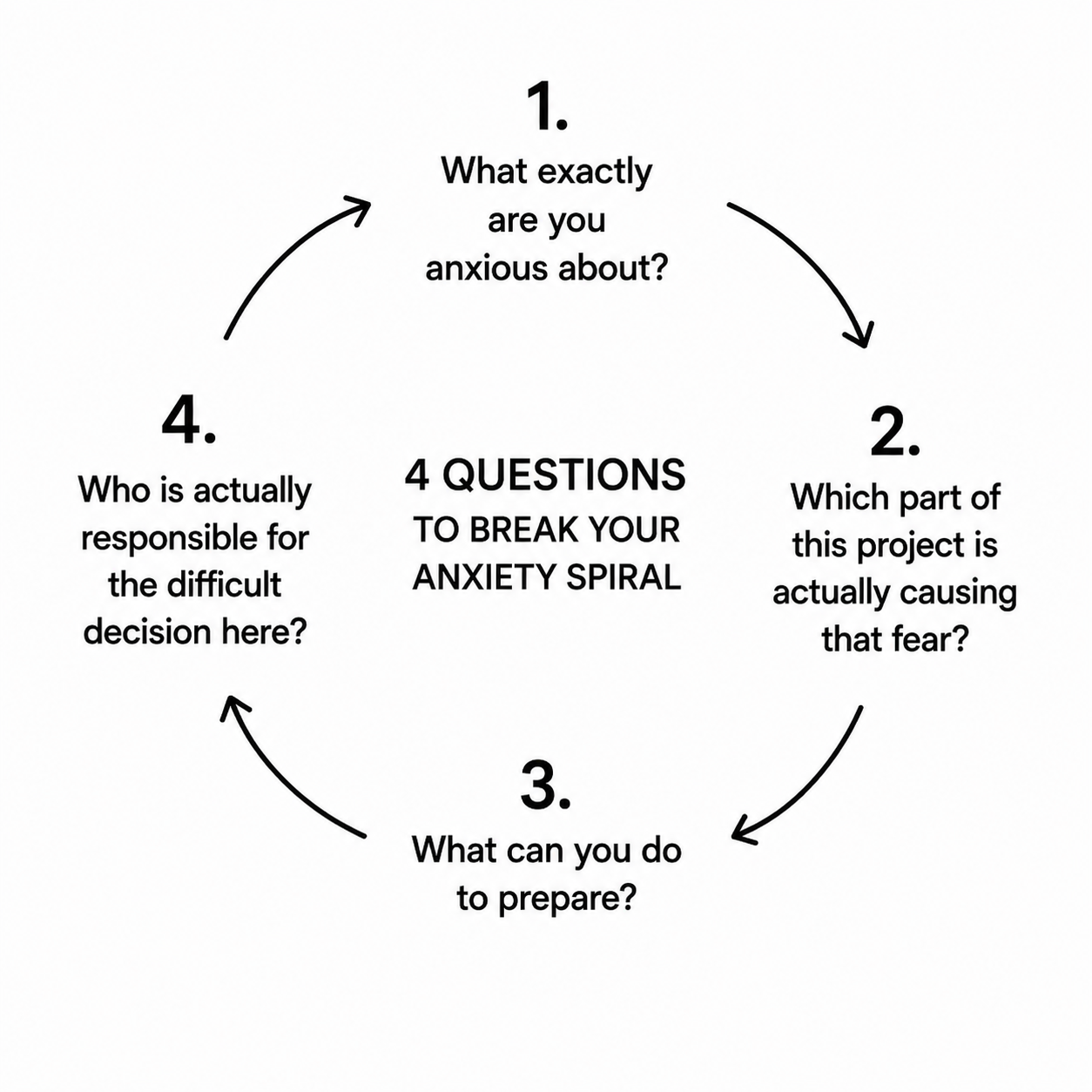
What exactly are you anxious about?
Start by getting clear on what you’re actually feeling.
- Is it the project itself?
- Is it the fear of failing?
- Is it how people will perceive you?
- Is it the impact on your career?
Most of the time, the anxiety isn’t just about the task. It’s about what it means for you.
Which part of this project is actually causing that fear?
Break it down. Don’t treat the entire project as one big problem.
- Identify the specific areas that feel risky or uncertain.
- Be honest with yourself.
- Is it a lack of clarity?
- Is it dependencies on other teams?
- Is it something outside your control?
When you narrow it down, the problem feels smaller and more manageable.
If you have read this far, consider supporting my work with a coffee ☕. Completely optional.
What can you do to prepare?
Now that you know the real source of fear, focus on solutions.
- What can you do within your control?
- Can you narrow the scope?
- Do you need support from others?
- Can you prepare stakeholders for possible outcomes?
- What’s the next best step, even if the outcome isn’t fully in your control?
Preparation reduces uncertainty, and uncertainty is what fuels anxiety.
Who is actually responsible for the difficult decision here?
Be clear about ownership.
- Are you accountable for driving the work, or for the outcome?
- Who needs to make the tough decision?
- Have you been carrying responsibilities that aren’t yours?
- Can you involve the right stakeholders instead of taking it all on yourself?
You can do your best, but you’re not responsible for everything.
Why this actually works
Talking to yourself from a second-person POV creates distance between you and your thoughts.
- It helps you be more objective.
- It forces you to find answers instead of getting stuck in the spiral.
- It shifts the conversation from fear to action.
- It helps you see what’s in your control and what’s not.
It doesn’t make the anxiety disappear immediately, but it gives you clarity and relief.
If this helped you even a teeny tiny bit, consider subscribing.
See you in the margins.