I Spent a Year Trying to Lose 22 Kgs. The Weight Wasn't Even the Problem
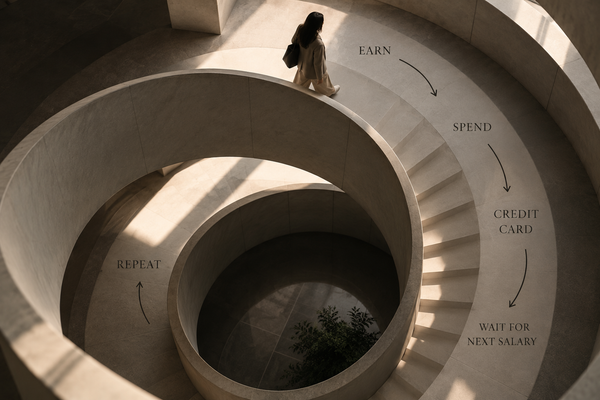
I had a plan after the sleep apnea diagnosis — strength training, calorie deficit, protein loading. I lost 4.5 kgs in 14 months, then nothing. What I'd been ignoring all year was a script someone else had written for me long back.


I felt pathetic and angry with myself every night I slept with a BiPAP machine strapped to my face. This was my second rock bottom in a span of four years. Is this going to be my life? Is this how it ends?
I have been in the same health-brainwash loop for most of my life. Multiple dietitians who made me starve, who barely advised me to eat more protein or do strength training. Fitness gurus whose advice confused me more - some said eat ghar ka khana, which I did only to gain more weight, while some said to sniff food. Fitness influencers whose bodies looked like they were sculpted, promising a body like theirs in just 6 months, tempting me to reach for that, only to fail and repeat the process all over again to amass nothing but disappointment.
Chapter 2 of Notes From My Health Journey — A series on how I transformed my health from rock bottom to living an active life.
In this post:
- The 14 months of calorie deficit that taught me discipline weren't the thing I was missing.
- How I broke the obsession with weight I'd been carrying around for thirty years.
In Aug of 2024, when I was put on a BiPAP machine indefinitely for my sleep apnea, I knew deep down something had to change. It was a rock bottom I never saw coming. My health impacted every major aspect of my life, hell, the entire life actually! And none of the promises I saw on social media or from the dietitians seemed to work for me. What else could I do? How was I going to become a healthy person from the inside? How do I lose the 22 kg that my doctor set as the target?
The frustration was helping to stoke the fire I was building inside. I knew I had to rely on the template that was successful before - strength training in 2017 when I lost 15 kgs. When I had already given everything a shot, then what was the harm in trying a method that had worked before?
The Initial Weight Loss Fantasy Trap
I started looking for apps and YouTube channels for a long-term workout structure. I found many trainers offering strength training, but none providing a structured 60/90-day training plan. Eventually, I discovered two trainers - Heather Robertson and Caroline Girvan - both of them providing not one but multiple training workouts in structured and long-term formats. I decided to go with Heather; I was intimidated by Caroline's madness in workouts. I bought the weights and workout clothes and got fixated on getting myself in shape.
I am not kidding when I say that I hated every second of those workouts. On the first day, I saw stars in front of my eyes. I just couldn't finish the workout. It was so damn difficult. And like an excited and hopeful toddler, I jumped on the weighing scale within a week, expecting to see some drastic results. No prizes for guessing the result. The workouts continued for three months, and I barely saw any weight reduction. I did see changes, however, in the way my body looked and felt. My waist and hips dropped three inches, and clothes started to fit better. But I was unsatisfied. I wanted to shed the kilos off my body and not just the inches.
I then started targeting my diet. Mind you, I was not monitoring my food intake or the portions at all during those three months. After careful research, I came across the term TDEE for the first time. TDEE stands for Total Daily Energy Expenditure. It represents the exact number of calories your body burns in a single 24-hour period, factoring in basic bodily functions, digestion, and all physical movement. I calculated my TDEE as 2200-2300, and I understood that to lose weight, I had to eat fewer calories than that range, which meant 1700-1900 calories a day.
I then bought a premium HealthifyMe subscription and a food scale to measure my portions. I scoffed and laughed when I portioned my food according to what I had entered in the app. According to the app, I was supposed to eat 150 g of cooked rice at a time, but I was actually eating 250-300 g of rice earlier in one meal! During the first week of calorie deficit, all I could think about was food. I would constantly check the time until the next meal and had to control my hunger pangs, especially in the evening.
The scale finally moved, and I lost 2 kilograms after a month of strict calorie deficit. This motivated me to research more on how to take my calorie deficit to the next level without feeling hungry, which led me to blogs highlighting the importance of protein during a calorie deficit and for strength training.
I slowly upped my protein to 100g — short of the 165g suggested by tdeecalculator.com (a gram per pound of body weight, which felt ridiculous to me). This meant I had to eat way too much protein, and I wasn't sure I could handle it. I started noticing improvement during my strength training and, most importantly, stopped feeling hungry. My hair and skin improved drastically. But the weight loss stalled after the fourth month.
I was only able to lose 4.5 kilograms on a calorie deficit, and by the fourth month, the weight had plateaued at the new number. Despite following everything I could, from the fourth month to the fourteenth month, there was no progress in weight loss. So what went wrong?
I was sold on the story of weight loss
I hate to disappoint you, but nothing was wrong in the entire process. The body was reacting based on how I was feeding or treating it. All this time, I was so fixated on losing the weight that I tortured myself with being in a calorie deficit for more than a year when it should just have been three months. The body is extremely adaptive, and it naturally adapted to the new TDEE number, which became the new baseline. I ignored the 3-inch loss around my waist and hips, I ignored the muscles that were forming underneath those fatty tissues, I ignored how my energy got better, and how my focus improved drastically. All I could do was obsess over my weight.
The ignorance of my other health attributes was deliberate. All my life, I have been told or rather, every single woman out there was told, to measure our fitness through our weight and BMI. Based on my height, I should be 58 kgs. The constant teasing and comparisons with other girls my age who were slim and looked better than me became an irritating constant for me. And if that wasn't enough, all I had to do was look up how to lose weight on Google, and there would be hundreds of search results suggesting different ways to starve oneself to bring the number down. I have always considered my body and structure to be on the healthier side, bordering on being a handsome woman. But I was labelled as an obese woman by a BMI calculator probably not created for Indian body types and 'moti (fat)' by almost everyone I knew in and out of my family. The obsession with my weight did not start from nowhere. It was ingrained through every single piece of advice, information and conversation I have had throughout my life.
You might also want to read Part One of this series - When My Body Stopped Negotiating: The Rock Bottoms I Couldn't Outrun
The hardest mindset shift I ever had to do
This is my second year of being consistent with my workouts. The progress is at a snail's pace, but months of researching, experimenting, and seeing my body react positively instilled courage in me to try out different phases of building my body. I learned about lean bulking, maintenance mode, calorie deficit mode (the correct one) and how every phase required me to be mentally strong and avoid the weighing scale because it will lead to disappointment. The bulk phase was the hardest thing I had to do. Here I was trying to frantically lose my weight while the bulk phase increased it, but that weight was actually 90% muscle. This muscle growth cannot be seen on the scale itself, but I had to trust the process and go along. There was a time when I panicked seeing the scale moving towards the original number slowly. I became restless, but I didn't give up. I had to trust the process no matter what. And I did.
I have just finished my bulk phase of 6 months, and I can see the formation of muscles so clearly. I am not yet ready to share the images with the world, but I have been keeping track through pictures, and it feels good. And I eventually increased my protein intake to 120g-130g. Beyond this, I found it difficult to digest. And that's okay. What I want to convey here is that your fitness journey is a trial and error. Getting in shape in 6 months is a lie we are sold over social media. Everyone's body is different; some have underlying health issues, some don't. We cannot measure our progress with someone's online who is only documenting the success part of it, and then feel guilty about it. The only thing important is your mindset. You need to have a strong resolve. To build resolve, consistency is the answer. There are no shortcuts to long-lasting fitness; it's all about showing up for yourself every single day. You need to not think about wiggling your way out of not working out or not tracking your meals.
What this health journey taught me
- The scale was never the full story. My waist, hips, hair, skin, energy, focus — all of them had been responding for months.
- The obsession with weight didn't begin with me. It was handed down — through years of body shaming, through a BMI calculator not built for Indian body types, through years of being compared to others. I was following a script written long before I had a scale.
- Somewhere in this journey, I decided to break the plateau and started reading my body in a language other than weight. And it has been absolutely freeing.
I'm still in the middle of this. If a question came up while you were reading, drop it in the comments.
If this helped you even in a teeny tiny way, you can support my writing with a coffee ☕, completely optional.
Thanks for reading. See you in the margins.